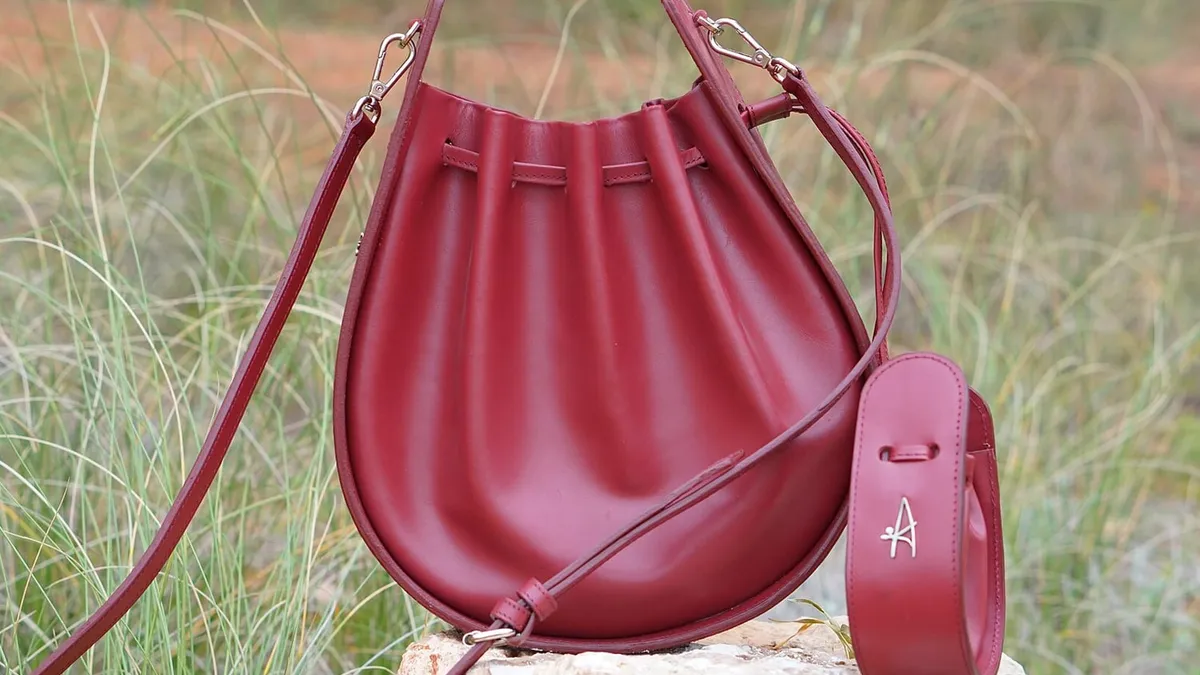
Two bags can look equally good on a shelf and behave completely differently after a year of carrying a laptop, a water bottle and a set of keys. The outward signs that shoppers are trained to read, the grain of the leather and the weight of the hardware, are only part of the story. What decides whether a bag keeps its shape or folds in on itself is largely hidden: how the panels are cut and joined, how the edges are finished, how the lining is attached, and where the hardware is mounted.
None of that is visible in a photograph, and most of it can be judged in a few minutes with the bag in hand.
Panel layout and grain matching
A bag is assembled from panels, and the number of them matters. Fewer, larger panels mean fewer seams and fewer places to fail, but they cost more because they use more of the hide and force the maker to cut around defects. A body built from many small panels can be perfectly sound, and it is often a sign that the maker was working through offcuts.
Grain direction is the second part. Leather stretches more across the hide than along it, so a panel cut in the wrong direction will sag where a correctly cut one will not. On a well-made bag, panels that meet at a visible edge are usually cut from similar areas of hides, so they age at the same rate rather than showing mismatched grain on the front face.
Edge finishes
Edges are where a bag shows its construction. A folded and stitched edge is the strongest and the most expensive: the leather is turned under and sewn, so the cut fibre is protected and the edge holds its line. Painted edges, where a coating is applied to the raw cut, are normal and can be durable, but the coating seals the fibre rather than replacing it. A paint bead laid over an unburnished edge chips first at the points where the bag folds, such as the hinge of a flap.
Raw or burnished edges sit at the other end. They look deliberate and can age well, but they are less resistant to moisture and to the abrasion of a bag set down repeatedly on the same corner.
How the lining is attached
The lining decides how the inside of a bag survives. A stitched lining is sewn into the seams and moves with the bag. A glued lining is faster to assemble and fails at the mouth of the bag, where the hand pulls it open daily, and the glue releases into a loose flap that catches on everything.
Material matters less than attachment, but it is not irrelevant. Textile linings are light and inexpensive and can wear through at the corners. Leather and microfibre linings generally outlast them. What should be checked is whether the lining is anchored at the top edge or hanging free, because an unanchored lining will work loose at the point of most movement.
Hardware and where it is mounted
The strength of hardware is mostly about what it is made of and how it is fixed. Solid brass and solid stainless steel wear well and can be re-plated or left to patinate. Die-cast zinc and aluminium are lighter and softer, and plated finishes on them lose their coating at the contact points.
Mounting is where a bag reveals its quality. Hardware fitted through a reinforced tab of leather, secured with a rivet or a screw through several layers, will hold. Hardware pressed into a single thin layer, or attached to the lining rather than the body, will pull through once the bag is loaded. The stress points are predictable and worth checking individually: the points where the handles or straps meet the body, the shoulder strap clips, the zip pulls, and the underside of the strap where it rubs against a shoulder.
Zips deserve separate attention. A metal zip in a heavy gauge, with a pull that is solidly attached and a slider that moves without wobbling, is doing structural work on a bag that opens widely. A lightweight coil zip on the same bag is fine as a pocket closure and poor as a main closure.
Reinforcement and the base
A structured bag holds its shape when empty because of interlining or stiffening between the lining and the outer leather. This is why a structured bag weighs more than a soft one of the same size, and why heavy stress on a structured bag can crease the stiffener rather than the leather.
A slouchy bag is designed to fold, and that is a legitimate design rather than a fault. Even then, the base should be reinforced, because the base takes the load of everything in the bag and the abrasion of every surface it is set on. Feet, if present, protect the base at the cost of a little weight, and a double-layered base panel is the simplest sign that the maker thought about it.
Structural faults against cosmetic ones
Not every fault shortens a bag’s life. The distinction matters when judging a sale or haggling over condition.
- Structural: a seam that has begun to open, a glued lining that has released, a rivet or screw that has pulled through its mounting, a zip that has lost teeth, a handle that has stretched at its attachment. These change how the bag carries and will worsen with use.
- Cosmetic: surface scuffs, a patina that has darkened unevenly, colour transfer from clothing, light edge wear where the paint has rubbed. These change how the bag looks and do not affect its structure.
A bag with cosmetic faults and sound construction is often a better purchase than a flawless-looking bag with a glued lining and hardware mounted through a single layer.
A short inspection routine
Turn the bag upside down and look at the base. Open every pocket and look along the lining where it meets the top edge. Pull gently on each hardware fixing to feel for movement rather than relying on the look of it. Check the edges at the fold points, where paint chips first. Then judge the seams by consistency of stitch length rather than by whether they are visible.
If the base is reinforced, the lining is stitched, the hardware is mounted through several layers and the edges are finished rather than sealed, the bag has been built to be used. Everything after that is style.