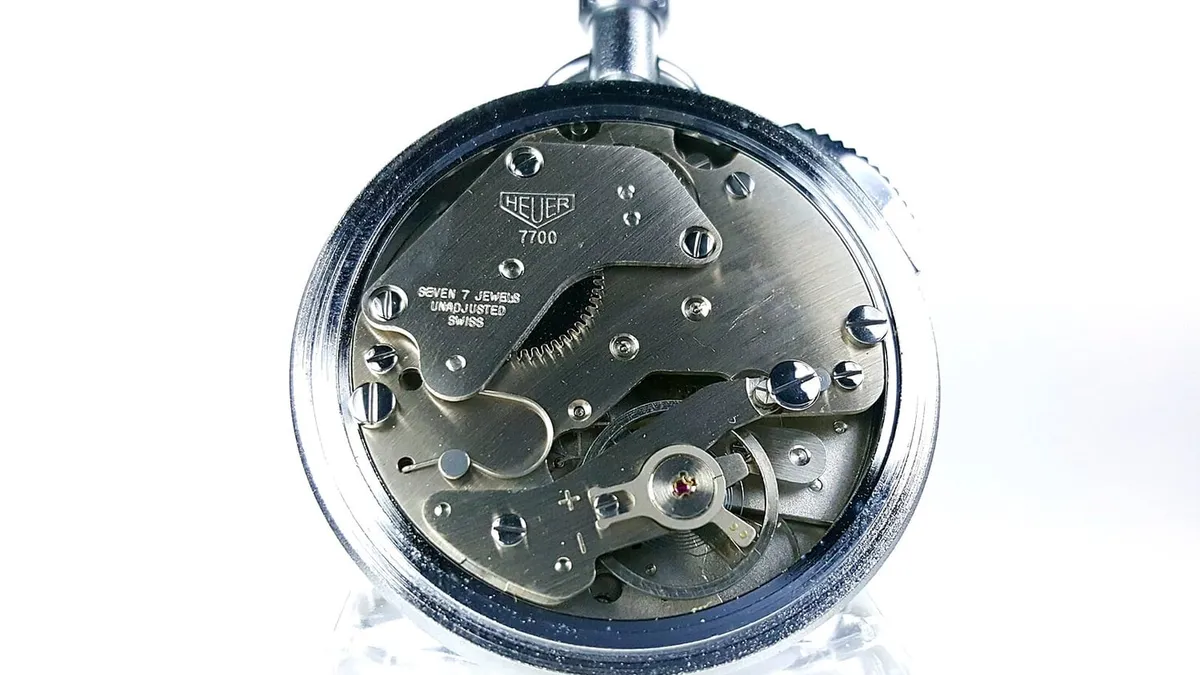
The movement is the part of a watch that is easiest to romanticise and hardest to evaluate from a photograph. Three families of movement dominate the market, and each one asks something different of the owner. None of them is inherently the “right” answer.
Quartz: accurate, cheap to keep, and often misunderstood
A quartz movement keeps time using a vibrating crystal, with the hands driven by a small stepper motor. Its advantages are real: accuracy measured in seconds per month rather than per day, no winding, and low maintenance.
Better quartz movements are thermocompensated, meaning the circuit adjusts for temperature, and some are accurate to a handful of seconds a year. Jewels, metal plating on the base plate, and a serviceable construction separate a good quartz movement from a disposable one.
The practical question with quartz is what happens when it stops. Some movements are designed to be dismantled, cleaned and lubricated, and others are simply replaced as a unit — which is cheap and effective, but means original parts vanish. Battery changes should include a new gasket and a pressure test if the watch is used near water, because a leaking battery can destroy a movement and a flattened gasket lets in moisture.
Hand-wound: thin, direct, and a small daily obligation
A hand-wound mechanical movement stores energy in a mainspring that you tension through the crown. With no winding rotor on top of the movement, the case can be much thinner, and the interaction is direct: you feel the mainspring through the crown and can judge its condition over time.
Modern hand-wound movements usually have a slipping bridle, so you cannot easily overwind one, but the crown action should still feel smooth rather than gritty. The trade-off is the habit: wind it at the same time each day, and accept that forgetting for a day or two means setting the time again.
Automatic: self-winding, with a rotor and a power reserve
An automatic movement adds a weighted rotor that swings as you move and winds the mainspring through a reduction gear train. Most rotors wind in both directions; some are designed to wind in one direction only, which is normal rather than faulty.
Two specifications matter in daily use. Power reserve is how long the watch runs off the wrist — commonly around forty hours on a conventional movement, longer on some. Winding efficiency is how quickly the watch recovers a full reserve from normal movement; a watch with a short reserve and modest efficiency may stop overnight if you stop wearing it on a Sunday.
Automatics are also thicker than hand-wound equivalents because of the rotor, which is often the honest reason a watch wears larger than its diameter suggests.
What the visible quality cues do and do not tell you
Open a display caseback and you will see finishing: beveled edges, circular graining, striped plates, blued or polished screws. Finishing is partly functional — polishing surfaces reduces friction in some places and traps debris in others — and partly decorative. A well-finished movement usually reflects a maker who cares, but decoration on a bridge can hide the fact that the surfaces underneath are rough, and a plain-looking movement can be extremely well engineered.
Jewel count is frequently used as a quality signal and mostly is not one. Jewels are low-friction bearings, and the correct number is whatever the design needs. More jewels than necessary can even be a marketing addition.
What is worth checking when you handle a watch:
- Winding feel and crown action, if hand-wound.
- Whether the rotor spins freely and whether it rattles when shaken gently.
- Whether the seconds hand stops when you pull the crown (hacking), and whether setting the time feels tight or vague.
- Whether the date changes cleanly, and when it starts to do so.
- Alignment: a minute hand that does not sit exactly on a marker when the seconds hand is at twelve is a finishing fault, not a design choice.
In-house versus bought-in
A movement made by the brand that sells the watch is not automatically better than one bought from a specialist manufacturer, and the specialist movements are frequently easier to service because more watchmakers have seen them and parts are more widely available.
What matters more is architecture. A modular chronograph, where a chronograph module is stacked on top of a base movement, is taller and has more interfaces than an integrated design. That is not a defect, but it affects service cost and case thickness, and it is worth knowing which you are buying.
Serviceability is the real long-term question
Every mechanical watch needs servicing sooner or later, and the deciding factor is who can do it. A movement for which any competent independent watchmaker can obtain parts will cost less to keep alive than a proprietary calibre that must be shipped to a service centre in another country.
Some modern quartz and exotic mechanical movements are replaced rather than repaired, which is fine while spares exist and a problem when they do not. Before buying an unfamiliar movement, ask directly: who services this locally, are parts available, and what is the typical turnaround? A watch you cannot repair has a limited life regardless of how well it tells the time today.
A short buying rule
For a first serious watch, choose a well-supported movement over an interesting one. Well-supported means a watchmaker within reach, parts that can be ordered, and a design that has been in production long enough to be understood. Novelty is enjoyable, but it should be a choice you make knowingly rather than a surprise you discover at the service desk.