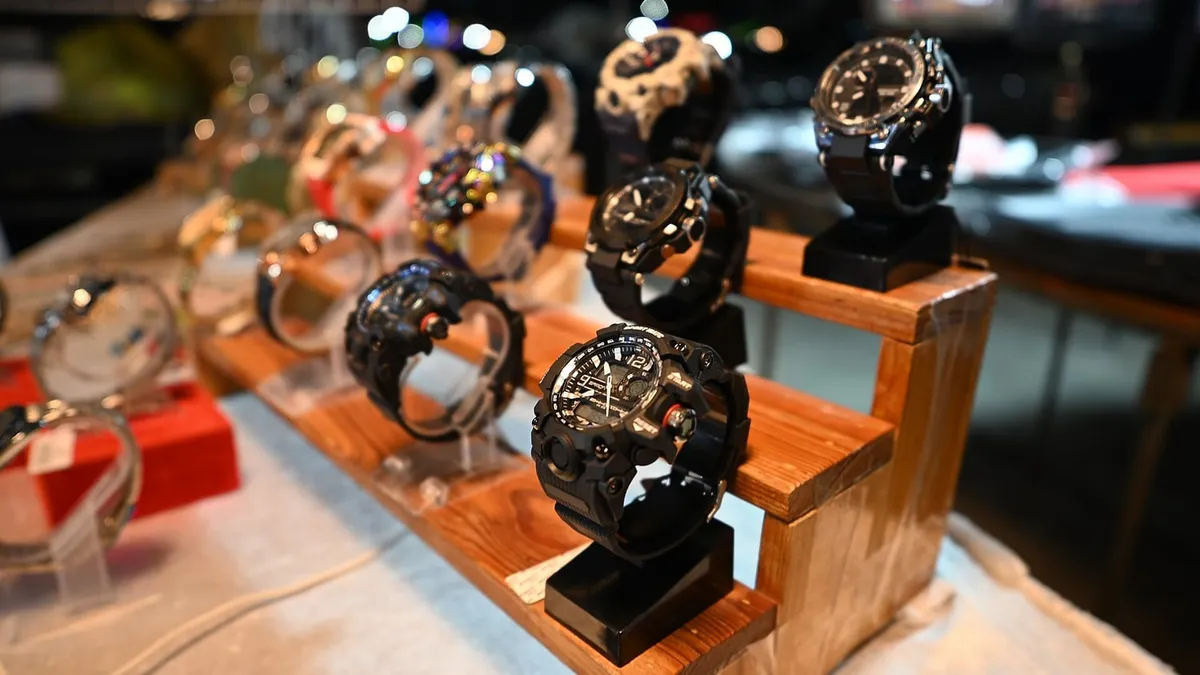
Storage damage is slow, which is why it is easy to ignore and hard to reverse. A bag put away damp, a watch left in a sunny window or a pair of shoes pressed against each other for a year will not show the harm immediately. It shows it later, as mould, fading, a set crease or a cloudy crystal, in each case after the condition that caused it has passed.
Conditioners and polishes get the attention, and they are the smallest part of the problem. The larger variables are humidity, light, dust and the shape an object is left in for months at a time.
Humidity and its targets
Leather, textile and paper all respond to moisture in the air. Too damp and mould grows; too dry and leather loses its flexibility and cracks along fold lines. A relative humidity of roughly 45 to 55 per cent suits leather goods and watches alike, and mould becomes a real risk as humidity climbs past about 65 per cent.
Everyday homes swing outside that band. A bathroom, a cellar and a garage are all poor places for long-term storage, and an unheated room in a damp climate is worse than a warm dry one. A simple hygrometer is enough to see what a room is actually doing, and silica gel in a closed container will hold the local humidity down if it is dried out periodically rather than left to saturate.
Light and ultraviolet
Ultraviolet light fades dyes, yellows pale leather, embrittles rubber gaskets and straps and attacks textile fibres. Direct sunlight through a window is the worst case because the heat rises with the light. A display shelf in full sun is a good way to ruin a bag over a summer.
A watch dial and its lume are also affected, and not always for the worse in the eyes of a collector: a faded bezel or dial is the visible result of light doing exactly what it does. Where the goods are meant to stay in the condition they were bought, keep them out of direct sun and use a drawer, a cabinet or a dust bag rather than an open shelf.
Dust and abrasion
Dust is abrasive, and it collects in exactly the places that move. Grit in the gap between links of a steel bracelet turns into a fine lapping compound that wears the pins. Dust on leather settles into the grain and into stitching, and it abrades the surface every time the bag is handled.
Dust bags solve most of this. They should breathe, so that moisture can leave, rather than be airtight. Sealed plastic traps the humidity that was in the air when it was closed and holds it against the object.
Shape retention and stuffing
Leather and textile hold the shape they are left in. A bag stored empty and folded will crease at the fold and stay creased. A bag overstuffed will stretch at the seams and distort its panels, and one stuffed with newsprint can pick up ink.
Acid-free tissue paper or a folded cloth works for the body of a bag, filled loosely enough that the bag holds its form without strain. Handles and straps should be laid inside the bag or supported, not left to hang, because a strap stored under tension will crease where it crosses the edge. Shoes benefit from a lightly filled shape and separation from each other, since two shoes pressed together will mark each other at the contact points.
Watches, straps and bracelets
Watches have their own storage rules, and the strap is usually the part that suffers. A leather strap left attached and stored tightly curled will take a set that no amount of wearing removes, so a watch kept in a box for months is better stored off its leather strap or with the strap laid flat around a curved cushion.
Metal bracelets should be kept dry and clean, since trapped moisture and salt promote corrosion at the pins and springs. A quartz watch with a battery left in place for years can leak, and a solar watch kept in the dark will discharge and may not recover. For a collection, a dry, dark drawer at room temperature with the straps relaxed is better than a glass display case in daylight.
Cases, drawers and dust bags
The container matters less than the conditions inside it. A wooden drawer is fine, though some timbers release acids that tarnish metal over decades. A lined watch box or a fabric dust bag is adequate for most goods. Airtight plastic boxes are useful only if a desiccant is included and refreshed, otherwise they concentrate moisture rather than exclude it.
Whatever the container, position decides the outcome. Away from radiators, away from windows, off a damp floor and not under a pipe or against an external wall.
Rotation as a maintenance habit
Regular use is itself maintenance, because leather that flexes stays supple and metal that moves stays free. Rotation is the practical way to get that benefit without wearing one item out. Bringing each bag into use a few times a year, winding each watch, checking for mould at the seams and looking for insect damage in wool and textile linings turns storage from a set of conditions into a routine.
Any item that will genuinely not be used for a year or more is better sold than stored, since storage costs attention even when it costs nothing else.
A storage routine
Work to a short routine rather than to a set of products:
- Keep the space dark, dry and between roughly 45 and 55 per cent relative humidity.
- Store each item in a breathable bag or a lined box, not on open display and not in sealed plastic.
- Stuff bags and shoes lightly with acid-free material, and keep straps and handles relaxed.
- Separate items that would press against each other for months at a time.
- Rotate the collection a few times a year and inspect the seams, the linings and the metal for early signs of damp, light or dust.
Done consistently, that routine does more for a collection than any conditioner applied after the damage has started.