A watch case is built to last decades. The strap holding it to the wrist is not, and it is the part that fails first in almost every case. Leather stretches and cracks, rubber tears at the lug end, textile frays at the buckle and steel bracelets develop play at every pin and spring. None of this is a fault in the watch. It is the normal working life of a part that takes sweat, friction and load from the moment it is buckled.
Reading how each material fails is what separates a strap replaced in good time from a watch lost on a pavement.
Leather
Leather straps are the most comfortable and the shortest lived. They are usually two or three layers bonded together: a top layer, a lining and sometimes a filler, stitched along both sides. The failure points follow from that construction.
Sweat and body oils break down the lining first, since it sits against the skin. The strap then delaminates at the top and bottom edges where the layers separate, and cracks appear at the point where the strap bends through the buckle. A strap that is beginning to crack at the lug end or at the buckle hole is close to failing, because both are points of repeated flex.
Rotating two leather straps and letting each dry between wears roughly doubles the life of both. Water and heat are the enemies: a leather strap should not be worn swimming, and should not be dried on a radiator.
Rubber and silicone
Rubber straps resist water and sweat, which makes them the practical choice for swimming and for humid climates. Vulcanised rubber is the more durable material and is typically stiffer and heavier. Silicone is softer and more flexible and attracts dust and lint, which can make it look tired quickly.
Both fail in the same place, at the lug end, where the material is thinnest and takes the loading from the spring bar. A tear often begins as a small crack at the edge of the mounting hole and grows across the strap. Because a failed rubber strap can pull free under load, a visible crack at the lug is a reason to replace rather than to continue.
Textile and nylon
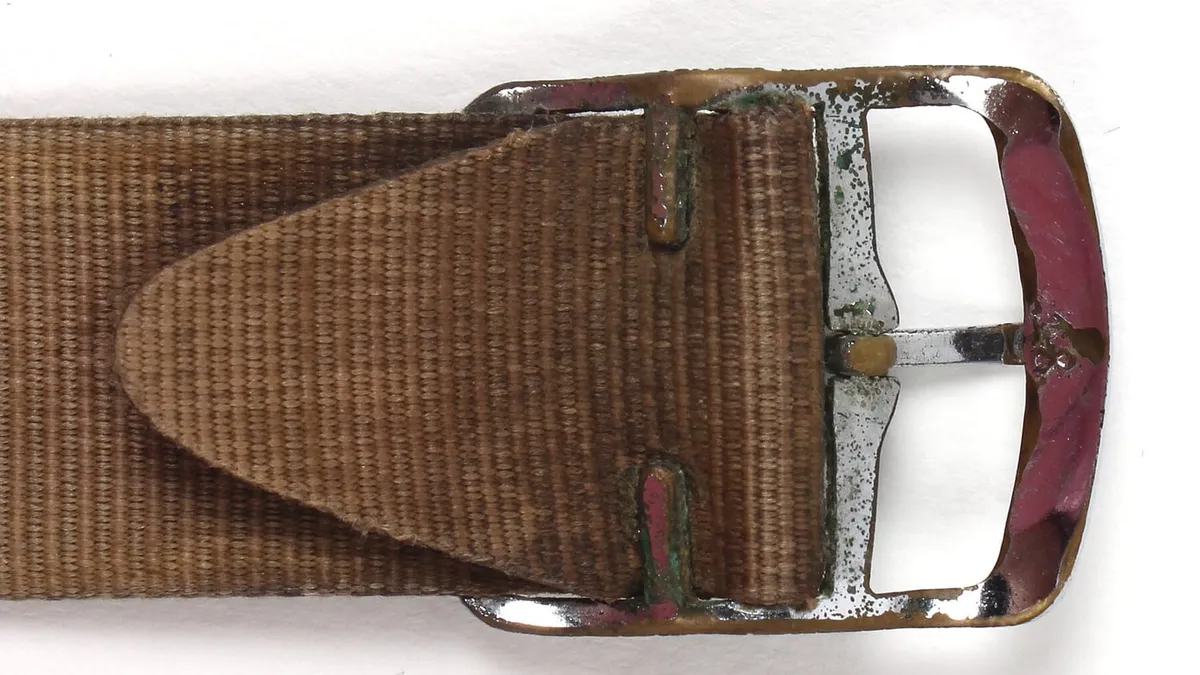
Textile straps, including the single-pass nylon designs, are cheap, washable and comfortable in heat. The webbing is usually nylon or a polyamide, with a buckle and keepers in steel or a plated metal. The watch sits on top of the strap rather than between two pieces, which makes them easy to fit and easy to remove.
Their weaknesses are fraying at the buckle holes and at the tip, fading under ultraviolet light and mould in humid storage. Nylon webbing also stretches slowly under load, so a long-worn strap will need the buckle moved. Washing a textile strap by hand in mild soap, then letting it dry fully in air, keeps it usable for years, and it is the only strap type that is genuinely easy to clean.
Steel bracelets and clasps
Steel is the most repairable option and the slowest to fail, but it does wear. Links are joined by pins, screws or friction pins, and each joint accumulates grit and salt that grinds the contact faces. The result is stretch: the bracelet lengthens and the joints become loose, so the bracelet no longer holds its shape.
Screws are the easiest to service, because they can be removed and re-tightened with the correct driver, and they are the type least likely to be damaged by adjustment. Friction pins and split pins need a proper tool and can be deformed if they are reused. Folded links are lighter and cheaper and can develop rattles; solid links hold their shape. Clasps take the most handling, so their springs, hinges and the fold-over arms wear first, and a clasp that springs open is a functional fault rather than a cosmetic one.
How each material fails, and the warning signs
- Leather: cracking at the buckle and lug, delamination along the edges, a dark and softened lining. Replace at the first crack, not at the break.
- Rubber: a splitting hole at the lug end, a crack that crosses the strap, hardening and shine on the surface. Replace immediately once a tear begins.
- Textile: fraying at the buckle holes and the tip, stretching that moves the buckle past its adjustment, fading and mould. Wash and inspect; replace when the weave opens.
- Steel: looseness in the links, a bracelet that has grown longer than its nominal size, worn pins, chewed screw slots, a clasp that will not stay closed. Service or replace the worn links.
Spring bars and quick-release
Every strap or bracelet is held by two spring bars, and they are the cheapest component in the assembly and the one most likely to cause a loss. Standard bars are fitted by compressing the ends into the lugs, and they can be fitted or removed with a small tool. Quick-release bars have a small lever built in, so no tool is needed, which makes swapping straps easy and slightly increases the chance of accidental release.
Bars come in diameters, and a thin bar in a wide lug hole will rattle and wear the holes. Fitted bars, drilled lugs or screw-in bars should be used where the maker provides them, because the load from a wrist is carried entirely through those two small pieces of steel.
Sizing and adjusting a bracelet
A bracelet should be sized so that the clasp closes without the watch sliding down onto the hand, and so that the case does not press into the back of the wrist. Removing links from both sides of the clasp keeps the case centred. Micro-adjustment holes in the clasp take up the small changes that follow from heat and from adding or losing a little weight, and a half link, where the bracelet offers one, is a finer adjustment than a full link.
Curved end links should sit flush against the case. A gap at the lug line is often a sign that the bracelet is not the one intended for that case, which affects both comfort and value.
A rule for replacing
Treat the strap as a consumable and inspect it at every battery change, service or cleaning. Replace leather at the first crack, rubber at the first tear, textile when the weave opens, and have a steel bracelet re-pinned when the links begin to move under their own weight. The strap costs a fraction of the watch, and it is the part whose failure the watch pays for.