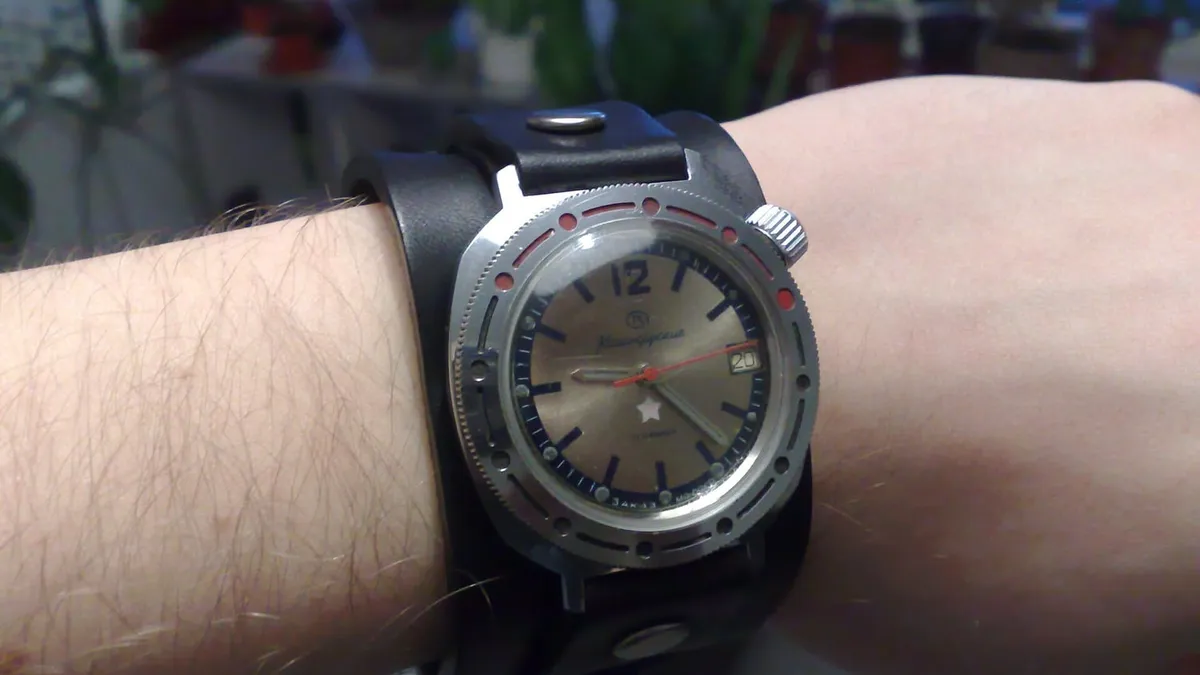
The measurement most buyers take before choosing a watch is the circumference of the wrist, and it is the least useful one available. A wrist is not a cylinder. It is oval in section, narrowest from front to back, and the surface a watch actually rests on is the flat or gently curved top. Two wrists of 17 cm can present very different platforms for a case, which is why two people with the same measurement disagree about whether 40 mm is large.
Case diameter receives the attention because it is the number printed first. It records how far the case measures across, usually excluding the crown, and nothing about how much of the wrist the watch occupies or how it behaves once it is on.
The number that predicts fit
Lug to lug, the distance from the tip of one lug to the tip of the other, is the figure to compare against the wrist. The lugs are where a watch stops fitting. When they extend past the flat upper surface of the wrist, the case tips and the watch overhangs the arm, which reads as oversized regardless of the diameter.
A workable rule is to measure the width of the flat top of the wrist, then keep lug to lug at or slightly below it. A 44 mm lug to lug on a wrist with 48 mm of flat surface will sit within the arm. The same watch on a wrist with 42 mm of flat surface will not, and no amount of strap tightening changes that.
Curvature changes the effective size
Two watches with identical lug to lug and diameter can wear differently because of how they curve. Lugs that bend downward, a mid-case with a rounded profile and a domed caseback all bring the watch down around the wrist rather than perching it on top. A flat case with straight lugs holds its full length above the arm, so it feels larger than its measurements suggest.
This is why watches with generous diameters and pronounced curvature can be comfortable on wrists that a smaller but flatter watch overwhelms. Curvature is rarely published, so it has to be judged from side photographs or in person.
Thickness, cuffs and the back of the case
Thickness is measured from the back of the case to the top of the crystal, and a domed crystal adds apparent height. Thickness decides two things: whether a watch slides under a shirt cuff, and whether it feels top-heavy.
The shape of the caseback matters as much as the number. A watch of 12 mm with a pronounced dome sits higher on the wrist than one of 12 mm with a flat back, because the dome rests on the middle of the wrist and lifts the case. A thick, wide watch also concentrates its mass high above the arm, so it rolls on the wrist during movement. A watch that is 11 mm or under generally disappears under a cuff; past 14 mm, many cuffs will not close over it.
Bracelets, taper and the first link
On a bracelet, the case is only half the fit. The way a bracelet articulates near the lugs decides whether it wraps or stands away, and the taper from case to clasp changes how the weight is distributed. A bracelet that narrows towards a slim clasp feels lighter and less rigid than one that keeps its width to the end, even when the two weigh the same in total.
The end link matters too. An end link shaped to the case closes the gap at the lugs; a straight end link on a curved case leaves a visible step and can pinch. Lug width, quoted in millimetres, determines which straps and bracelets will fit, and a fractional difference is enough to leave a gap that is visible from the side.
Why the wrist measurement misleads
Wrist circumference is dominated by the underside, which never touches a watch. A tape measure wrapped around the arm also changes with time of day, temperature and hydration, so the same wrist can read differently in the morning and the evening. None of that predicts how a case will sit, because the case sits on the flat top, not around the whole circumference.
Wrist width from one side to the other, measured across the flat, is a more honest figure, and it is the one to note before ordering.
Reading a profile before committing
Where a watch cannot be tried on, a paper template is more informative than any product photograph. Trace the case outline, including the lugs, onto card at the published dimensions, cut it out and lay it across the wrist. The overhang, if there is any, becomes obvious.
It helps to measure a watch that already fits well and record its lug to lug, thickness and weight, then compare those figures with anything under consideration. Wrist shots taken on a phone are unreliable for this purpose: the lens is close to the subject, which makes the case in the foreground look larger and the wrist behind it look smaller than either is.
A rule for fit
Check four things in order, and let each one lead to the next:
- Lug to lug against the width of the flat wrist, so that the lugs stay within it.
- Thickness against the tightest cuff the watch will be worn under.
- Caseback shape, to judge how high the watch sits once the dome rests on the wrist.
- Bracelet articulation, whether the first links wrap rather than stand away from the arm.
If those four are met, diameter is a matter of preference rather than a problem, and the same case can read as understated on one wrist and oversized on another without either reading being wrong.